
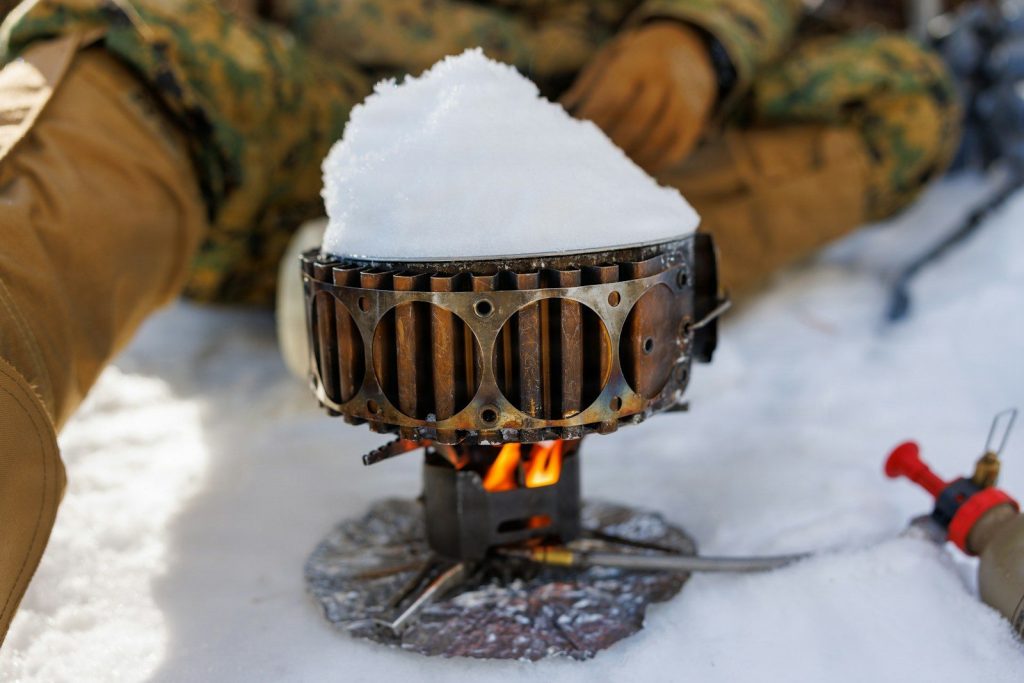
When sub-zero blizzards howl outside your four-season tent and the mountain landscape is buried under feet of snow, your camp stove transforms from a simple culinary luxury into a critical piece of life-support hardware. In deep winter conditions, you cannot rely on natural water sources; every fluid ounce you and your team consume must be actively rendered by melting ice and dense snow packed into a cooking pot.
However, extreme cold wreaks havoc on standard summer cooking gear. Standard canister stoves screw directly onto compressed gas shrouds, but as temperatures plummet, internal canister pressure drops, leaving you with a weak, sputtering flame—or a completely dead stove.
To survive and thrive in winter environments, you need specialized hardware engineered to fight cold-weather physics. Based on thermal output efficiency, fuel stability, and cold-weather mechanical reliability, here are the top 5 winter camping stoves available on Amazon built to conquer extreme freezing environments.
The Sub-Zero Thermal Performance Matrix
| Stove Model | Fuel System Type | Cold-Weather Mechanics | Best For | Boiling Speed (Snow/Ice) | Standout Engineering Feature |
| MSR XGK EX | Liquid Fuel (White Gas/Kerosene) | Pressurized fuel line (No canister frost) | Extreme Alpine / Arctic | Ultra-Fast (Industrial) | Multi-fuel shaker jet self-cleaning |
| MSR WhisperLite Universal | Hybrid (Liquid Gas or Canister) | Inverted canister stand option | Cold Backpacking / Basecamp | Fast / Highly controllable | Shifting between fuel formats easily |
| Soto WindMaster | Integrated Canister | Built-in micro regulator | Lightweight Sub-Zero Trails | Medium-Fast | Maintains pressure down to $20^\circ\text{F}$ |
| Jetboil Joule | Inverted Canister System | Liquid-feed inverted design | High-Altitude Group Camp | Ultra-Fast | Integrated 2.5L flux-ring pot |
| Camp Chef Everest 2X | Propane Gas (High-Pressure) | Heavy regulated 10k BTU burners | Car Camping / Basecamp | Rapid (Large batch) | Impervious to cold propane tank drops |
Top 5 Winter Camping Stoves Vetted on Amazon
1. The Indestructible Expedition Standard: MSR XGK EX Multi-Fuel Stove
For over three decades, whenever mountaineers, arctic explorers, and extreme military units head into the world’s most hostile freezing zones, the MSR XGK is the absolute default choice.
-
Why It Wins: This stove doesn’t use standard canisters; it runs on pressurized white gas, kerosene, or diesel pumped manually from a heavy-duty fuel bottle. Because liquid white gas does not suffer from cold-weather pressure drops, it generates a massive, jet-engine-like thermal output even at $-40^\circ\text{F}$. Its rigid, oversized burner effortlessly supports huge pots filled with dense, heavy snow blocks.
2. The Versatile Backcountry Hybrid: MSR WhisperLite Universal Stove
If you want the raw power of a traditional liquid-fuel winter stove but still desire the clean, lightweight convenience of a screw-on canister system for late autumn or early spring camp trips.
-
Why It Wins: The WhisperLite Universal features patent-pending AirControl technology that allows it to burn white gas, unleaded gasoline, kerosene, or isobutane canisters seamlessly. For winter use, it includes an inverted canister stand. This allows you to flip your gas canister completely upside down, forcing liquid fuel directly into the fuel line where it is pre-heated into gas by the burner flame.
3. The Ultralight Mountaineer’s Choice: Soto WindMaster Stove with Micro Regulator
For lightweight winter thru-hikers who log huge miles in heavy backpacking boots and want an ultra-compact setup without carrying heavy liquid fuel bottles.
-
Why It Wins: Traditional canister stoves die in the cold because as the gas inside expands and discharges, the canister naturally freezes. Soto solved this by engineering a microscopic internal pressure regulator. This internal valve dynamically adjusts fuel flow, allowing the WindMaster to maintain a steady, high-output flame even when the canister temperature drops down to $20^\circ\text{F}$ ($-7^\circ\text{C}$).
4. The High-Volume Snow-Melting Machine: Jetboil Joule Cooking System
If you are winter camping with a group or family inside a large winterized pop-up tent and need to melt gallons of snow into drinking water rapidly without wasting fuel.
-
Why It Wins: The Joule features an inverted canister design coupled with a massive, integrated 2.5-liter cooking pot equipped with a proprietary FluxRing heat exchanger. The liquid-feed system prevents fuel freeze-up, while the engineered flux-fins capture almost 80% of the burner’s heat, allowing you to boil a full liter of ice-cold water in less than 2 minutes and 45 seconds.
5. The Heavy-Duty Winter Car Camping King: Camp Chef Everest 2X Stove
For overlanders, basecampers, and family winter adventurers who pull their trucks right up to the winter campsite and need a massive cooktop.
-
Why It Wins: While lightweight canisters fail in sub-zero weather, heavy, green 1-pound propane bottles manage cold weather significantly better because propane has a boiling point of $-44^\circ\text{F}$. The Everest 2X features two massive 20,000 BTU burners managed by an industrial-grade pressure regulator, allowing you to prepare premium meals or brew rich camping coffee in freezing mountain winds.
3 Critical Thermodynamic Rules for Winter Cooking
1. Always Invert Your Canister in Sub-Zero Weather
When using standard isobutane/propane canister gas in winter, the canister cools down rapidly during use due to evaporative cooling. If the canister sits normally on its base, only the volatile propane gas escapes, leaving the cold, liquid butane trapped inside, causing your flame to die.
-
The Pro Move: Only use winter canister stoves that feature a remote fuel line and an inverted canister stand (like the WhisperLite Universal or Jetboil Joule). Flipping the canister upside down forces the liquid fuel directly into the metal pre-heating loop near the burner head, transforming it into a high-pressure gas before ignition.
2. Isolate Your Cooking System from the Cold Ground
Never place your winter stove or gas canister directly onto bare snow or frozen ice sheets. The freezing ground acts as an infinite heat sink, rapidly conducting precious thermal energy away from your fuel source and dropping canister pressure to zero.
-
The Pro Move: Always construct a solid insulation platform for your stove. Pack a small, lightweight piece of closed-cell foam pad, a square piece of thin plywood, or a flattened aluminum foil wind-shield to place beneath your stove assembly. This keeps your fuel isolated from the sub-zero snowpack.
3. Prime Your Liquid Fuel Stoves with Surgical Precision
If you choose a heavy-duty liquid fuel stove like the MSR XGK, you must manually “prime” the stove before it can run. This means you must allow a small pool of liquid white gas to flow into the priming cup underneath the burner, turn off the valve, and ignite it.
-
The Pro Move: The initial priming flame will burn high, yellow, and smoky for roughly 60 seconds. This intense flame is designed to heat up the generator tube. Once the tube is scorching hot, slowly crack open the fuel valve. The liquid fuel passing through the hot tube will instantly vaporize, shifting the stove into a roaring, highly efficient blue flame.
FAQ: Resolving Sub-Zero Fuel Logistics
Q: Why shouldn’t I cook inside my tent vestibule during a winter storm?
A: While it is tempting to escape freezing winds by cooking inside your tent, doing so introduces two massive safety hazards: Carbon Monoxide (CO) poisoning and catastrophic tent fires. Liquid and canister stoves generate high amounts of odorless, deadly CO gas when melting cold snow blocks. Additionally, as noted in our guide on nighttime camping safety, a single flare-up during the priming phase can ignite modern nylon tent fabrics within two seconds. Always cook in a well-ventilated exterior area or a dedicated open tarp shelter.
Q: Is white gas better than propane for winter camping?
A: For extreme backcountry backpacking, mountaineering, and true arctic conditions, white gas (liquid fuel) is vastly superior. It is highly energy-dense, works flawlessly down to $-50^\circ\text{F}$, and is easily packed inside refillable aluminum bottles. For winter car camping, high-pressure propane gas is fantastic because heavy steel propane tanks manage freezing temperatures beautifully and offer residential-style cooking control.
Final Thoughts
Conquering the winter wilderness requires total command over your thermodynamic tools. Transitioning from a basic summer pocket burner to an engineered winter system like the MSR XGK EX, the hybrid WhisperLite, or a regulated Soto WindMaster ensures that you can melt snow, hydrate your team, and prepare hot, life-saving meals regardless of how low the thermometer drops. Protect your fuel pressure, isolate your gear from the snowpack, and face the frozen trails with absolute technical confidence!
Best Winter Camping Gear: Essential Equipment for Cold-Weather Adventures
Disclaimer: As an Amazon Associate, I earn from qualifying purchases. Handle highly flammable fuels with extreme care, ventilate properly, leave no trace!