
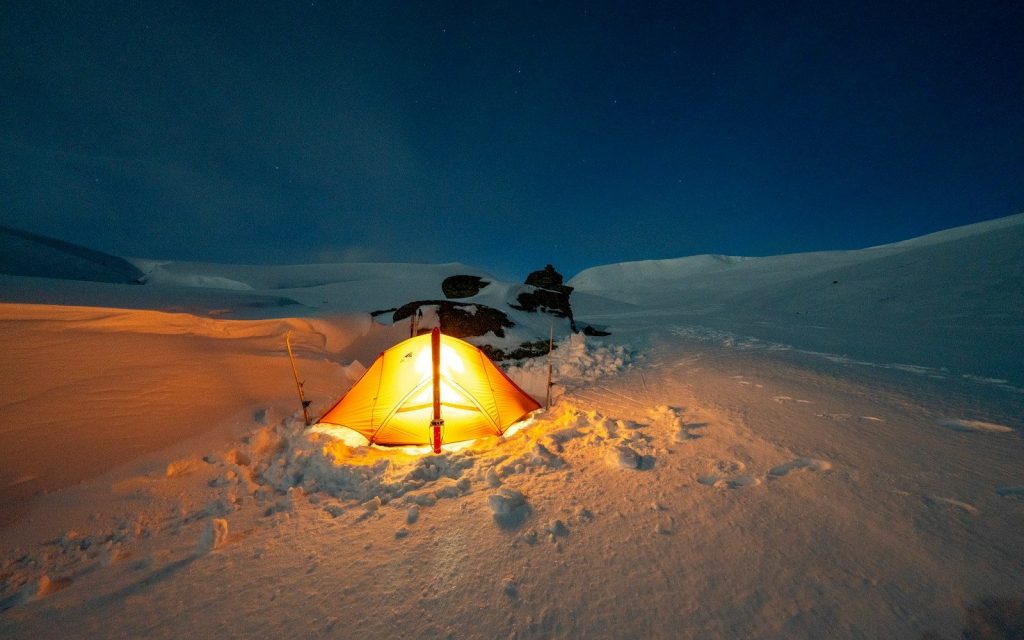
When planning a winter camping trip or setting up a snowpack basecamp, managing your lighting systems requires a total shift in logistics. During short winter days, twilight sets in early, leaving your campsite shrouded in deep freezing darkness for up to 15 continuous hours.
In sub-zero wilderness environments, standard consumer rechargeable lanterns introduce severe physical and battery failures. Extreme cold dramatically slows down the chemical reaction inside lithium-ion battery cells, causing voltage drops that lead to sudden, premature power shutdowns. Furthermore, cheap plastic housings become brittle and crack easily under cold impacts, and cold-white LED output bounces off pure white snow blankets, producing harsh, blinding glare and severe eye fatigue.
To maintain absolute perimeter security and internal shelter comfort, a true winter camping lantern must be engineered around cold-weather optics and power redundancy. This means deploying high-capacity batteries insulated inside thermal housings, warm-spectrum LED arrays, and multi-fuel or manual charging capabilities.
From heavy-duty basecamp anchors to ultralight cold-vetted tent lights, here are the top 5 lanterns for winter camping available on Amazon tested for sub-zero performance.
The Sub-Zero Lighting Performance Matrix
| Winter Lantern Model | Power Architecture | Max Lumens | Max Run-Time (Low) | Light Spectrum / Temp | Best Used For | Key Cold-Weather Feature |
| Goal Zero Lighthouse 600 | Li-ion / Hand-Crank / Solar | 600 Lumens | 320 Hours | Warm Amber (3000K) | Off-Grid Winter Camps | Built-in mechanical hand-crank dynamo |
| UST 30-Day Duro LED | 3 D-Cell Alkaline Batteries | 700 Lumens | 720 Hours (30 Days) | Soft White / Red SOS | Basecamp Multi-Week Freeze | Cold-resistant rubberized armor shell |
| Streamlight Super Siege | Rechargeable Li-Ion (AC/USB) | 1,100 Lumens | 348 Hours | Warm White & Red LED | Severe Arctic Storms | Completely waterproof & impact-proof |
| Black Diamond Apollo | Dual-Fuel (Li-Ion or 3 AA) | 350 Lumens | 90 Hours | Glare-Free Warm White | 4-Season Winter Tents | Folding legs elevate light off cold snow |
| LuminAID PackLite Max | Solar Panel / USB-C | 150 Lumens | 50 Hours | Diffused Warm Ambient | Ultralight Winter Backpacking | Collapsible insulated TPU floating pouch |
Top 5 Winter Camping Lanterns Vetted on Amazon
1. The Undefeated King of Power Redundancy: Goal Zero Lighthouse 600
When a severe winter storm traps you inside your shelter for days and depletes your standard power banks, the Lighthouse 600 guarantees light through pure mechanical kinetic energy.
-
Why It Wins: The Lighthouse 600 is the ultimate sub-zero insurance policy. It features a built-in, fold-out hand-crank dynamo. If the internal 5,200 mAh lithium battery drains in the cold, turning the handle for just one minute generates enough power for 10 minutes of light. It emits a soft, warm amber glow that reduces snow glare and incorporates folding legs to elevate the light source above loose snowpacks.
2. The Long-Distance Endurance Workhorse: UST 30-Day Duro LED Lantern
For long-term winter basecamps, snowmobile expeditions, or emergency blackouts where you need continuous, steady illumination for weeks without touching a charging cable.
-
Why It Wins: Running on three standard D-cell batteries, the UST Duro can burn continuously on its low setting for an incredible 30 full days (720 hours). Its outer shell is wrapped in a thick, impact-resistant rubber armor that prevents the plastic from becoming brittle in sub-zero freezes. You can remove the outer globe to convert it into a wide-angle ceiling downlight inside a 4-season winter dome tent.
3. The Industrial Submersible Brute: Streamlight Super Siege Rechargeable
When facing aggressive sub-zero blizzards, high winds, and icy rain where your equipment will inevitably be dropped onto frozen granite or packed ice.
-
Why It Wins: Built to tactical specifications, the Super Siege is an absolute tank. Encased in a heavy-duty polymer chassis with a thick rubber base, it easily survives 2-meter impacts onto solid ice. It pumps out a massive 1,100 lumens of light and includes a dedicated array of low-frequency red LEDs to preserve your night vision without reflecting harsh glare off surrounding snow banks.
4. The Ideal Tent-Ceiling Dual-Fuel Anchor: Black Diamond Apollo Lantern
For winter backpackers who want a compact, highly adjustable lantern to hang inside their tent vestibule or set down on a snowy camp table.
-
Why It Wins: The Apollo utilizes Black Diamond’s Dual-Fuel technology, running on either its internal rechargeable lithium battery or three standard AA batteries. This allows you to keep spare AA batteries warm inside your jacket pocket as an instant backup. Its folding, rubberized legs elevate the light body 4 inches off frozen snow surfaces, while the frosted globe diffuses light evenly to create a cozy, glare-free interior microclimate.
5. The Ultralight Insulated Floating Tile: LuminAID PackLite Max Solar Lantern
For minimalist winter thru-hikers and fastpackers carrying a waterproof backpacking pack who need lightweight gear that takes up minimal space.
-
Why It Wins: Originally designed for humanitarian disaster relief, the PackLite Max is an inflatable, floating lantern made of heavy-duty TPU plastic. Because the light source is surrounded by an air pocket, the air layer acts as natural insulation, protecting the internal lithium battery from cold ambient winds. It collapses flat to a 1-inch tile and features an integrated solar panel to charge passively on your pack frame during sunny winter marches.
3 Critical Tactical Protocols for Sub-Zero Illumination
To ensure your lighting hardware operates reliably under severe winter stress, implement these three scientific rules into your basecamp routine:
1. Isolate Batteries from Thermal Conduction
Placing a metal or thin plastic lantern flat on a frozen snowpack or ice sheet creates a rapid thermal sink.
-
The Physics: Cold ground conduction drains battery energy significantly faster than ambient cold air.
-
The Protocol: Never leave your active lanterns sitting directly on raw snow or frozen ground. Always elevate them using folding leg systems (like the Black Diamond Apollo), hang them from central tent ceiling loops, or set them on top of a insulated foam pad or kitchen chuck box. When sleeping at night, store your primary headlamps and compact battery packs inside your winter sleeping bag to preserve their charge.
2. Prioritize Warm Light Spectra (2700K–3000K)
Standard cool-white LEDs (5000K+) emit a high concentration of blue light wavelengths.
-
The Hazard: When cool-white light hits a pure white snowscape, it causes severe optical scatter and glare, making it difficult to judge terrain depth, ice patches, or snow drifts, while causing eye strain and headaches over long winter nights.
-
The Protocol: Choose winter lanterns that feature warm-white or amber LED arrays (2700K–3000K). Warm light wavelengths cut through falling snow and ice fog more effectively, bounce off snowpacks without blinding glare, and create a cozy, relaxing visual environment inside your shelter.
3. Store Alkaline Batteries Separately from Terminals
If you rely on lanterns powered by disposable alkaline batteries (such as D-cells or AAs) for long-term winter storage, never leave the batteries installed inside the terminal bays during transit.
-
The Chemical Hazard: Sub-zero temperatures followed by warm car transport cause metal terminals to contract and expand, increasing the risk of battery seal failures and corrosive acid leaks that can permanently destroy your lantern’s circuit boards.
-
The Protocol: Always store your spare cold-weather batteries inside a sealed, dry ziplock pouch tucked into an internal pocket of your backpack, and insert them into the lantern only when setting up camp.
FAQ: Outsmarting Winter Night Hazards
Q: Can I charge a solar-powered winter lantern on a cloudy winter day?
A: Yes, but charging efficiency drops significantly. Monocrystalline solar panels can still harvest UV rays through light cloud cover, but charging times will be 2 to 3 times longer than in direct sunlight. To maximize solar harvesting in winter, wipe all frost and ice off the solar panel lens regularly, and tilt the panel directly toward the low winter sun angle rather than laying it flat on the ground.
Q: Why is Red-Light Mode so important during winter night camping?
A: Red light features a much longer electromagnetic wavelength, which does not contract your pupils or destroy your night-adjusted vision. In a winter campsite, switching to Red-Light Mode allows you to step outside your tent to check guy-lines or monitor your winter camp stove without blinding yourself or your camp companions against the reflective snow blanket.
Final Thoughts
Navigating long winter nights requires moving away from fragile summer flashlights toward engineered, cold-vetted illumination systems. Upgrading your gear list to cold-resistant platforms like the hand-cranked Goal Zero Lighthouse 600, the long-running UST 30-Day Duro, or the dual-fuel Black Diamond Apollo completely eliminates the frustration of sudden battery failures. Keep your batteries elevated off freezing snow, utilize warm light spectra to eliminate glare, and store your backup power sources close to your body heat. Illuminate your camp with precision, stay safe through the dark hours, and dominate the most pristine winter singletracks with total confidence!
Best Emergency Camping Lights: Vetted Failure-Proof Survival Illumination
Disclaimer: As an Amazon Associate, I earn from qualifying purchases. Inspect your lighting O-rings annually to ensure total waterproof integrity in wet snow, stay warm, leave no trace!